I am an old fart now at 57 and read this article. I haven’t done all of his suggestions, such as bike fit and wider shoes, but really agree with some of them. Radar, larger screen computer, wider tyres and electronic gearing are some of the things I really appreciate.
Old fart at 57? … try 84 turning 85 in a month
Didn’t start riding until 68 and still knocking out 150km or so most weeks and hope to continue for a while yet.
Interesting article and have put most but not all suggestions into effect.
Wider shoes, radar, wider tubeless tyres with significant reduced pressure 55,58 psi, and when I turned 80 purchased a new Orbea Gain M20 E-Bike … far more than I ever expected to pay for a bike but worth it (not a lot of assistance is used on group rides when pace is generally above the 25kph cutoff but great on hilly rides)
This has allowed me to continue riding with my younger mates so happy with the decision.
Cataract surgery largely fixed the vision issue both long and short.
For my big 6 0 birthday last year I replaced my Roubaix that maxed out with 28c tyres, with a second hand Revolt with much wider tyres. Rough roads or gravel are more pleasant.
Electronic shifting and disk brakes were a bonus, but tyre size was the driver.
Bought reader style photochromatic glasses a few years back. Made reading the bike computer easier.
Upgraded my computer and ended up with a bigger screen, but this was to improve the navigation options rather than fit more data or make it readable. The glasses fixed the readability, and anyway I ride to enjoy myself rather than watch numbers - okay, I watch cadence.
Radar, it was on special.
Shoes. Sold my SPD-SL shoes and pedals with the Roubaix and have gone back to the SPD that I also had. But yes, feet do grow, I have gone up a size in walking shoes.
And I have just bought a second hand indoor trainer as I have got soft and won’t go outside riding if it is too cold.
57? Old? Harsh. I’m also 57. Picked up and read a copy of “The Senior” the other day, for over 55’s - full of whiny people complaining how expensive private health is and how to kick your adult children out. Hang on a tick…
I wear bifocal contacts but being able to read the screen gets harder every year. I’m still trying to keep my FTP around where it was 10 years ago, the VO2 is slowly declining in lock-step with max HR. Still running 23’s in preference to 25’s for the aero, still north of 200km/week, still smashing out the intervals. Not so aero on the bikes after rupturing the L5/S1 nine years back. I went back to racing Crit’s at the start of last year, back up in Master’s B. My strong advice is to have a training program, I throw it to Xert and let it work out where the training should take me.
The only thing slowing me down is the fear of crashing - at this age we don’t bounce, we break. I was diagnosed with osteopenia 10 years back. I know far too many people who have broken hips and clavicles and not healed fast or well.
I did have some +2 bbb cycling glasses with the reader insert. The tint coating wore/peeled off. I have a Garmin 1030+ with the large screen (and long battery life) and ditched the reader glasses. I can still see it quite well, luckily.
Yes I fell off on a fast bunch ride about 6 years ago and fractured R clavicle, 9 ribs, pubic rami and chipped a vertebra. Asked for a bone density test referral at my GP afterwards. Yep, osteopenia.
Age isn’t good for bone density but neither is cycling. The bones are not loaded enough. Weights bore me and running is out due to a microdiscectomy here.
I ride by myself these days, on days off. Where I want and when I want. Not in the cold and dark.
You need some new wider wheels if you are still runnning 23s. Fk that!
25mm int width wheels here running 30f and 32r at ~50psi each end and no slower but better comfort, grip, durability and versatility. Much better.
As I’ve approached the mid 60’s and reading about Osteopenia, just recently I asked my Dr about getting a bone scan which I did about a Month ago and I’m happy that my results came up good with a little bit of a banding on my right side hip area so that needs to be monitored a little but the Dr didn’t seem to be that concerned about it and told me that it wasn’t something to be concerned about right now. I might test again in 5 years. I haven’t been riding much over the past 12 Months but have been walking a fair bit and I know I should do more. I found that since my left hip replacement 6 years ago that my left leg has become somewhat lazy and drags a bit and I’ve lost a fair bit of weight over the past 2 years and along with that was the loss of some left muscle mass. I had bought a pair of leg warmers 12 Months ago and they were snug, now they just slide right down.
Bone density is relative to age, so just because your bones are as good as another person your age doesn’t mean good things. Those kids in their 20’s who get back up on the bike doesn’t happen in the … “elderly”. Mate of mine broke the top off his femur tripping on something and falling on his knee. Then shattered the other femur when the bike went out under him on a wet corner. Another mate got tipped off his bike by a scooter, broken hip. Surgical repair of clavicle fractures gets common because they just don’t heal on their own, one of the people I know had to have the plate removed because his bone density meant the screws were coming out.
According to the World Health Organization, osteoporosis is defined based on the following bone density levels:
A T-score within 1 SD (+1 or -1) of the young adult mean indicates normal bone density.
A T-score of 1 to 2.5 SD below the young adult mean (-1 to -2.5 SD) indicates low bone mass.
A T-score of 2.5 SD or more below the young adult mean (more than -2.5 SD) indicates the presence of osteoporosis.
In general, the risk for bone fracture doubles with every SD below normal. Thus, a person with a BMD of 1 SD below normal (T-score of -1) has twice the risk for bone fracture as a person with a normal BMD. When this information is known, people with a high risk for bone fracture can be treated with the goal of preventing future fractures. Severe (established) osteoporosis is defined as having a bone density that is more than 2.5 SD below the young adult mean with one or more past fractures due to osteoporosis.
Hmmm…yeah, I have the report somewhere and I’d have to dig under a mountain of other paperwork to find it but if I do find it, I’ll print up the score but the Doctor reckons for my age it’s a very good result so basically is all I want to know, however in any accident there’s a risk you’re going to land the wrong way or one could be lucky.
I believe another reason is why older people in middle age and seniors suffer with more injuries after a fall is because we just can’t react or twist our bodies to minimise the impact anymore, agility is not my strongest ability so I’m quite at risk of being seriously hurt as I couldn’t possible protect myself as well as I could at 30 or even 50.
With a Motorcycle you have all that protective gear but on a bicycle, the skin cops it and there’s no padding or cushion unless you’re Geared up for BMX.
Lucky I’m a slow rider eh…not much risk of high speed crashes here
“I believe another reason is why older people in middle age and seniors suffer with more injuries after a fall is because we just can’t react or twist our bodies to minimise the impact anymore”
Yes, probably very true. I was taught in my youth how to roll and absorb the impact when hitting the ground hard (went with the job) This has stuck with me over the years and the ingrained responses have saved me many times on motorcycle and bicycle incidents. However. now I’m 68, the latest incident - a high speed downhill gravel dismount - did not go so well as I did not get the shoulder around as quick as I used to… Lots of bruising and a couple of torn muscles. The instincts instilled by training still prevented worse (apparently, I bounced and rolled quite spectacularly) but I did not get the roll right and paid the price. You get slower as you get old, so I’m taking this as my warning to be a (lot) more careful .
But you’re doing that for wheel to tyre aero matching. This Conti tyre to rim chart says you can run 30s on 16mm inner rims.
Many XC race MTBs still have 25 to 30mm internal widths to run up to 61mm tyres. In the 90s, some MTB rims were 17mm internal. I have a number of them here. Most were 19mm IIRC. Which is still a lot thinner than many modern road rims.
I am running wider rims to allow wider tyres without an aero penalty true.
I needed new wheels when I switched to disc brakes. Made the conscious decision to go wider for the benefits wider tyres, with more volume, provide. I was slow to the party but the benefits are definitely there. Roads are crap here and comfort more a priority as I age. If I can do it without a speed penalty, why not? China direct, Light bicycle wheels. Been very happy with them but cheaper reliable options are out there now. Elite, Zen carbon, XMCS to name a few.
I’ll start by saying there is nothing wrong with the choice you have made for you.
But others don’t need to upgrade wheels to run wider tyres, which they probably already know. They just need to have the frame and fork width. That is my point. There are some benefits of wider rims besides aero like more tyre side flex stability, a little more volume, and a slightly different shaped tyre - which can be either good or bad depending on the tyre design and use. But all those benefits for an average rider are small compared to the added cost of upgrading wheels. The old diminishing returns apply. And yes I was an early adopter of wider wheels for road using a 19mm inner rear wheel with a 23mm tyre in about 2010. It made the tyre about 26mm. It was worth doing as an initial build for my mainly bike path use. But I wouldn’t swap out wheels just to run bigger tyres these days unless it was an extreme change.
Fair enough. You can however buy wider wheels from China for a very reasonable price. The volume increase with wider width does allow lower pressure and better ride/grip.
We are very different in our preferences. Cycling is my hobby/passion and I will spend more than you, who prefers utilitarian functionality, it seems.
Regardless, you don’t need to spend a significant amount to purchase something that is faster and more comfortable. Deep rims, when wider, also are less subject to crosswind steering moments ime. I have spent a long time on 50mm+ deep carbon wheels from back in my racing days. The person I was initially replying to is racing, so you would presume speed is still important.
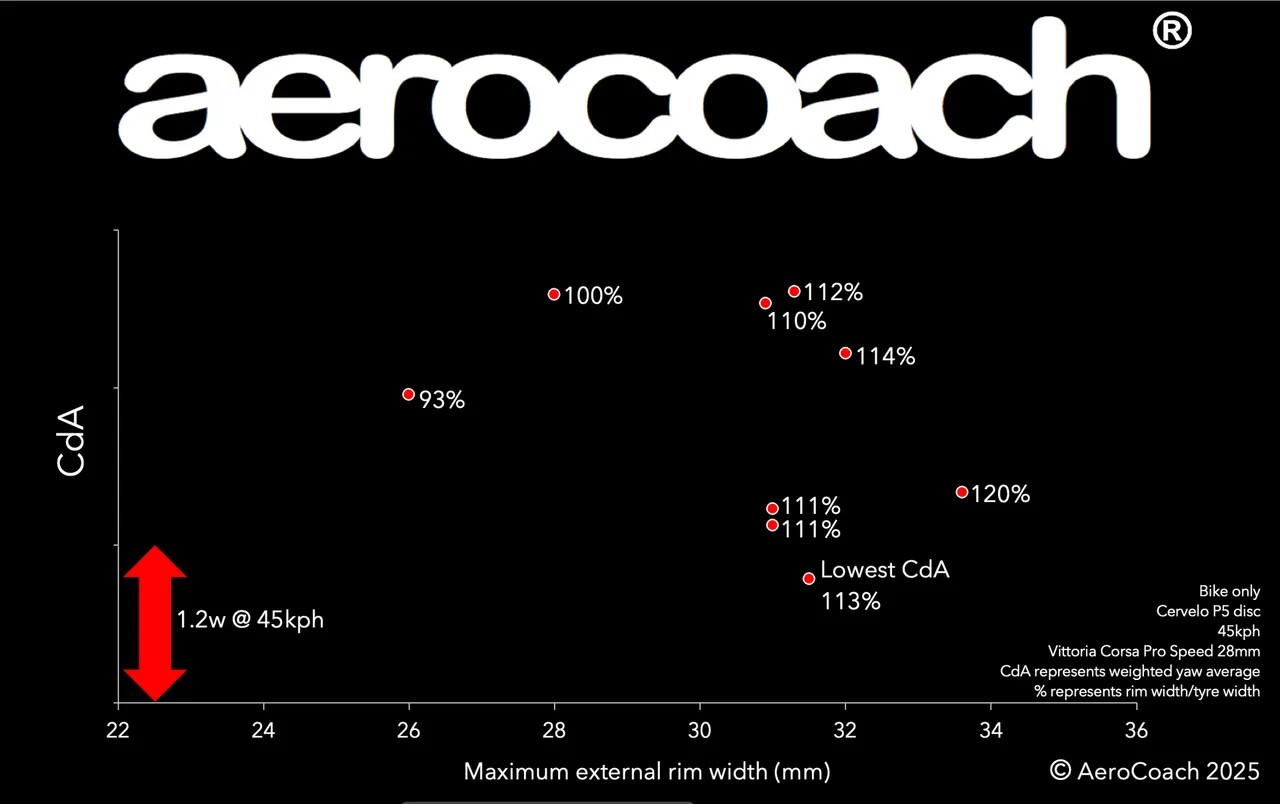
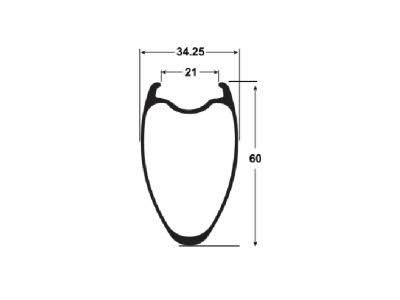
deCadence 60mm deep, 34.2mm wide, 25mm internal width. With 23’s. Because they are still faster than 25’s and these are my crit/tt wheels. The rule-of-thumb-of-105 still (in general) applies. Yes, I have to run higher pressures but comfort isn’t the aim.
My 60’s are more stable than my old 40’s and the 50’s that came with my Propel - those suckers could get very choppy at speed.
They are nice wide rims and actually wider than my WR50s are externally. I am wondering what makes you say the 23s are faster?
A 28 or 30 on those rims will still meet the 105 rule and have better rolling resistance. Better traction too for crits. The tyres run in the TT at the tdf are much wider than 23 (25 for Pog, 28 & 30 otherwise) from what I read. The 7 hottest time trial bikes at the 2026 Tour de France ahead of stage 16 | BikeRadar They are going much faster than you and I are able. On the road stages 30 and 32s I believe.
I miss TTs and may still race or would have raced for longer if they ran them where I live.
Quoted tyre sizes are for a 13mm internal width. I’ll have to pull out the calipers, but 23mm on a 25mm internal is quite a bit wider. Because the rim narrows down at the brake surface (rim brakes here!), the transition of the tyre to the rim is the important bit. But no filling of the gap, rolling resistance is killed by that. I’d expect the rim shape with disc brakes is where the modern rim/tyre is maintaining aero. But I had a heck of a time modifying pads to get the mini-V’s of the Propel to work with the wide rim. Shimano caliper brakes work just fine though.
I’ve also found that (brand dependant) measured width can be all over the shop and (example) the 23 and 25 Bontrager R tyres (my preferred training) are almost identical installed width. Might as well go with the lighter option.
The faster you go the less it matters about cross-wind aerodynamics. Narrow then wins. Shame about my lack of pace.


 .
.